Use the Gold Line ZM1P Impedance Meter
Quick Reference QR-GTS-002 · General Troubleshooting · Rev 1.0 · Oct 2026
Set it up, read it right and know what the number means on any 25 V, 70 V or 100 V speaker line, or an 8 Ω speaker.
📄 View or download this guide as a PDF
Click the PDF icon below to open it right here in your browser. In the viewer, use Download (top right) to save a copy, or the printer icon to print it.
🪪 Pocket card for the meter case: CC-GTS-001
Half-sheet, two-sided card with the switch settings and what the reading means. Print it, or use the 2-up file to print two per sheet and cut on the marks.
An impedance meter measures a speaker line the way the amplifier sees it: with an audio test signal, not DC. Set it to the line's voltage and it does the math for you, showing the load in watts you can compare straight to the speaker taps. Use it before a line goes on an amp, and any time a space is quiet, distorted or dead.
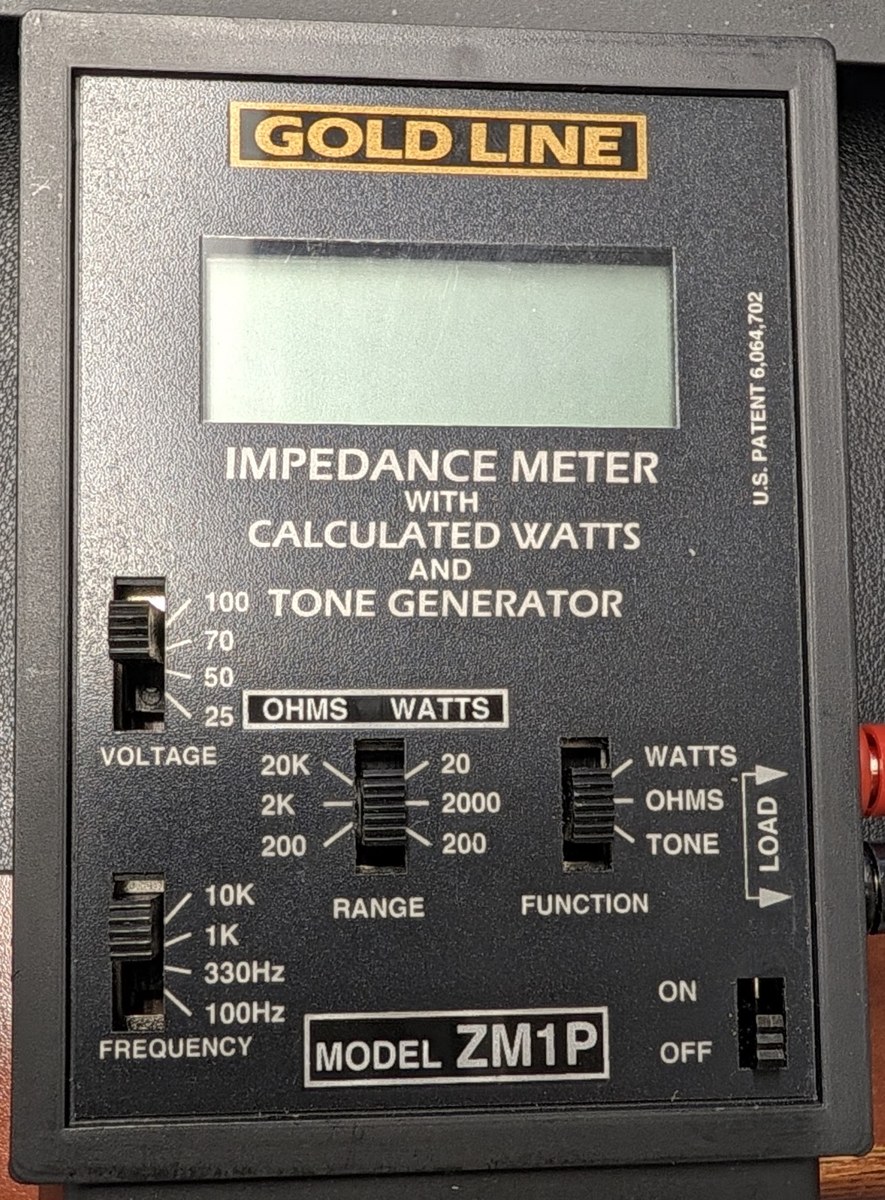
Gold Line ZM1P (VSC's meter). Top to bottom: display, VOLTAGE, RANGE and FUNCTION switches, FREQUENCY, ON / OFF. The test leads go in the LOAD jacks on the right side.
Know the switches
| Switch | Positions | What it does |
|---|---|---|
| Function | WATTS · OHMS · TONE | WATTS: the load as watts at the voltage you pick. OHMS: the load in ohms. TONE: sends a test tone out the leads (no reading in TONE). |
| Voltage | 100 · 70 · 50 · 25 | The line's system voltage. It only changes the watts math, not the test signal. US commercial lines are 70 V; some older US school systems are 25 V. |
| Range | OHMS: 200 · 2K · 20K WATTS: 20 · 200 · 2000 | Pick the lowest range that doesn't show 1---. That gives the most digits. |
| Frequency | 10K · 1K · 330Hz · 100Hz | The test tone's frequency. Use 1K for routine checks (Gold Line: data is "generally always taken" at 1 kHz). 330 Hz is also good for watts. |
| ON / OFF | ON · OFF | Turn it on after the leads are on the line. Off resets the protection relay. |
1️⃣ Check the meter before you trust it
- OHMS, leads apart: shows 1--- on every range.
- OHMS, leads touching: reads near zero (last digit 5 or less).
- WATTS, leads apart: 0 or nearly 0. WATTS at 70, leads touching: overrange (1---). This one doesn't work at 25.
- BAT on the display = readings are wrong. Replace all 8 AA alkaline batteries (4 Phillips screws on the back cover; close it carefully so you don't pinch the wires).
- A check fails with fresh batteries? Look for a bad test lead or corroded clips.
2️⃣ Take the line off the amplifier
- Disconnect the speaker line from the amp before measuring, even with the amp off. A connected amp changes the reading.
- Never on a live line. The ZM1P has a relay that protects it from amp outputs up to 120 VAC. If it trips, turn the meter off to reset it and get the power off the line. The older ZM1 has no protection and is damaged by a live amp.
- More than one home run on the amp? Meter one run at a time, ends apart and not touching.
3️⃣ Set it up and read it
For a 70 V line:
| Switch | Set to | Notes |
|---|---|---|
| Voltage | 70 | Use 25 on a 25 V system, 100 on a 100 V system. |
| Frequency | 1K | 330 Hz also fine for watts. |
| Function | WATTS | Compares straight to the tap total. Use OHMS when a guide gives you an ohms limit (for example AE's 19 Ω minimum on a CZA-1300). |
| Range | 20 first, then 200, then 2000 | Move up only when it shows 1---. |
Clip the leads on the run's two conductors, then turn it ON.
Read the display. Where the decimal point lands depends on the range. The display maxes out at 1999.
| Function | Range | Shows up to | Example |
|---|---|---|---|
| OHMS | 200 | 199.9 Ω | 21.4 = 21.4 Ω |
| OHMS | 2K | 1999 Ω | 304 = 304 Ω |
| OHMS | 20K | 19.99 kΩ | 0.28 = 0.28 kΩ = 280 Ω |
| WATTS | 20 | 19.99 W | 16.4 = 16.4 W |
| WATTS | 200 | 199.9 W | 96.0 = 96 W |
| WATTS | 2000 | 1999 W | 018 = 18 W (whole watts only) |
Ohms to watts at 70 V: watts ≈ 5,000 ÷ ohms. 304 Ω ≈ 16 W; 21 Ω ≈ 240 W. At 25 V: watts ≈ 625 ÷ ohms.
4️⃣ What the reading means
| You see | It means | Do this |
|---|---|---|
| Close to the tap total | The line is wired as designed. | OK to connect. On an AE CZA-1300 the line should be within about 10% of the taps and 240 W or less (QR-AE-040). |
| Well below the tap total | Part of the line isn't connected: a broken or unlanded branch, missing speakers, a speaker tapped lower than drawn. (VSC reading.) | Split the run and meter each section; check taps. |
| Above the tap total | Extra speakers on the run, a tap set higher than drawn, or a damaged transformer. (VSC reading.) | Check taps against the drawing, then split the run. |
| Over about 600 W and near 8 Ω | A speaker is wired straight to the line, skipping its transformer (Gold Line). | Check each speaker on the run. |
| Under 8 Ω and far above the design (over about 1,000 W) | Likely a short in the wiring. It can damage the amp (Gold Line). | Don't connect. Find and repair the short. |
| 1--- on every OHMS range, or about 0 W | Open: nothing connected, or the run is broken. | Check the leads are on, then walk the run. |
Gold Line: a real system often reads different from its rated impedance by up to 20%, and long wire runs read higher at 10K. Keep using 1K and compare against the design guideline (AE: within about 10% on a CZA-1300 line).
Real readings: one 15 W speaker
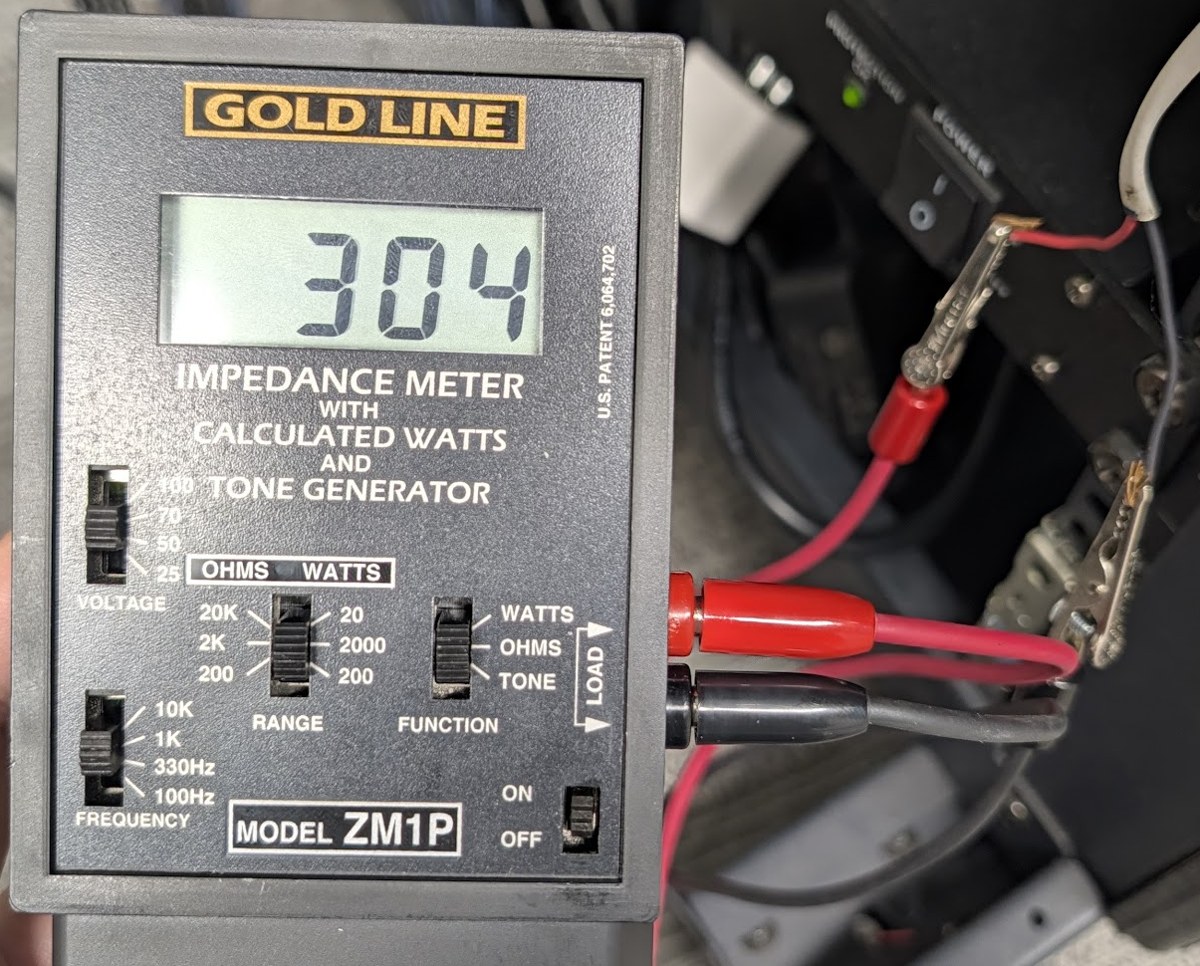
VSC shop test: one AE SP-0300 on its 15 W tap through a wall volume control at 10. 70 V, 1K, OHMS, 2K: 304 Ω ≈ 16 W. A good match for 15 W.
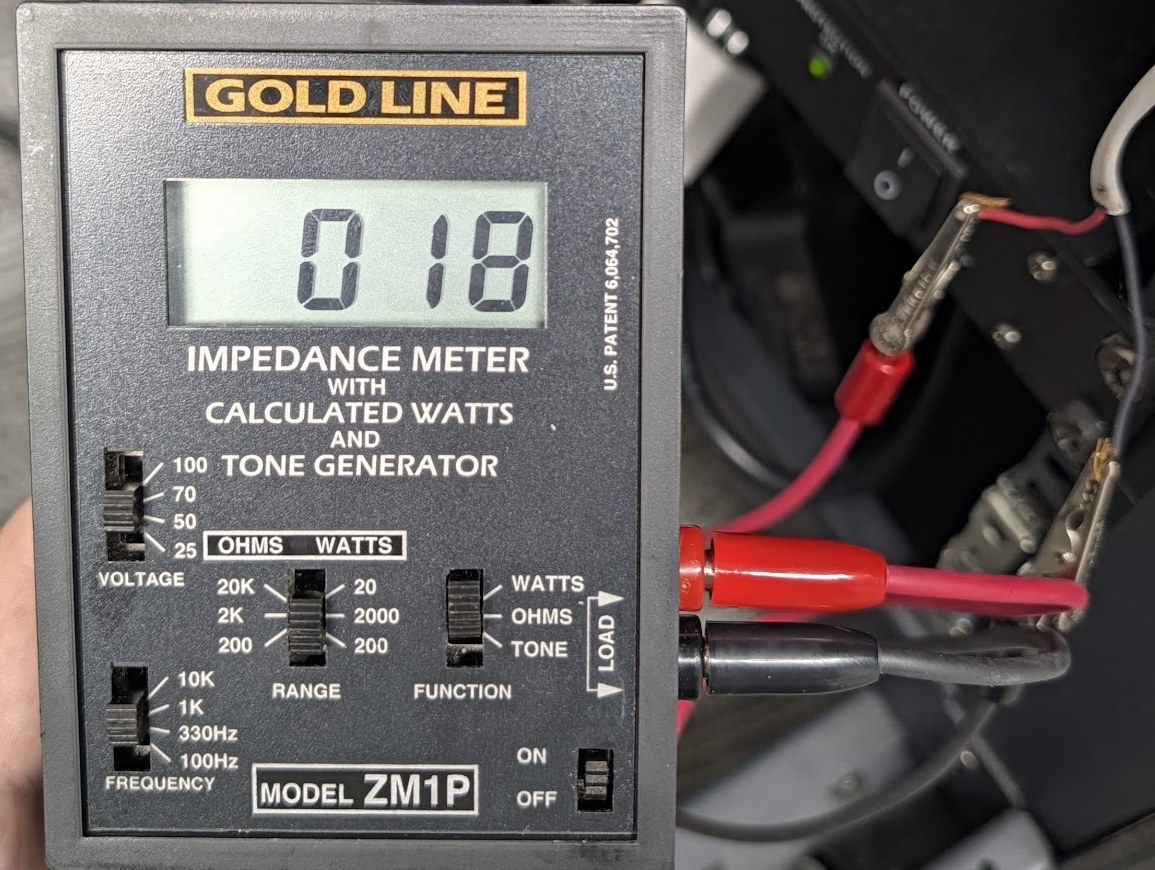
Same speaker, 70 V, 1K, WATTS, 2000 range: 018 = 18 W. The 2000 range only shows whole watts, so a reading this small belongs on the 20 range (expect about 16.x).
More uses
- Check a speaker's tap before you hang it: WATTS, the line voltage, 1K (or 330 Hz). A 5 W tap should read about 5 W. Write it down.
- Test a wall volume control: meter the line at the control's highest setting, then turn it down. The watts should drop. No change = the control isn't doing anything. (VSC tip.)
- 8 Ω speakers (MSx classroom speakers, low-impedance amps): use OHMS at 330 Hz or 1K. Gold Line suggests recording a speaker's reading at all four frequencies as its "signature" for later comparison.
- Find the speakers on a line with TONE: the ZM1P sends a line-level tone (400 mV) meant for an amp's Aux input, not the speaker line. Amp off, connect the leads to the aux input, meter on, then the amp on: every speaker on that amp should play the tone. Ignore the display in TONE.
Why not a regular multimeter
A multimeter on Ω measures DC resistance: the copper in the transformer windings. It doesn't see the load the amplifier sees. The same SP-0300 at 15 W reads 17.8 Ω on a Klein MM400. By the 5,000 ÷ ohms math that looks like 280 W and a near short, on a line that is really 15 W. A multimeter is only good for open (OL) or dead short (near 0 Ω).
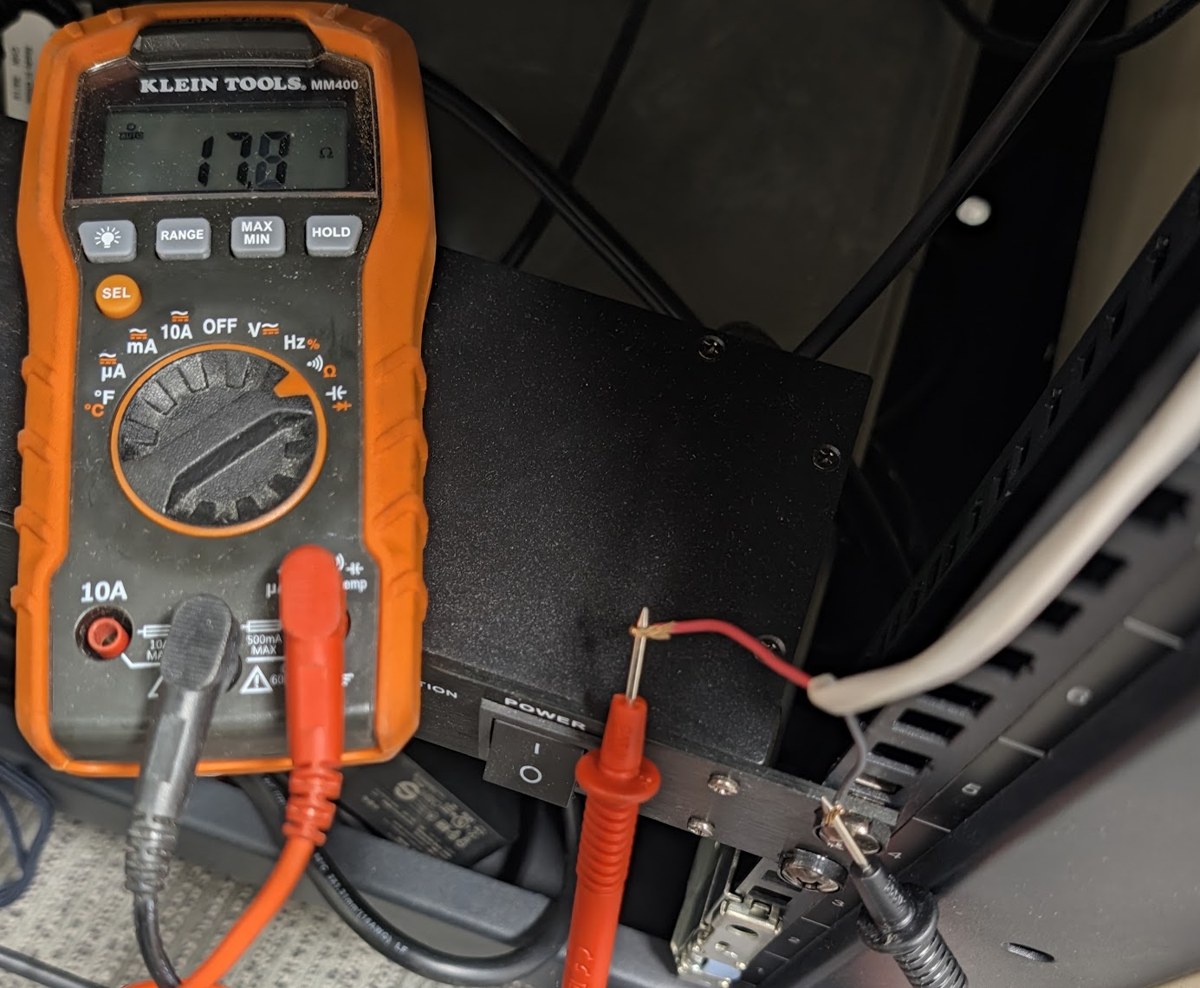
Wrong tool: 17.8 Ω on a 15 W speaker.
Field tips and tricks
- Write it down. Each run's reading and its tap total go on the as-built and the Field Service worksheet. Next visit, a change jumps out.
- Label runs before you lift them so they go back on the right terminals.
- Same settings every time (70 V, 1K, WATTS) so readings compare from visit to visit.
- Spare batteries: keep 8 AA in the case. Never try to charge alkalines.
- Reading jumps around? Check the clips are on bare copper, not insulation or oxidized wire.
- Pocket card for the meter case: CC-GTS-001 Gold Line ZM1P Meter Card, attached to this guide in the VSC KB.
📚 Sources & credits
- Compiled by Brad Roy, VSC Director of Operations. "Below / above the tap total" readings and the volume control test: VSC field practice.
- Gold Line ZM1 / ZM1P / ZM2N Impedance Meter manual: switches, quick checks, batteries, display ranges, relay protection, fault guidance (600 W / 8 Ω, short), frequency guidance, TONE output, 20% system variation.
- Audio Enhancement: CZA-1300 Manual DC-41133.0525 (19 Ω minimum); AE training Level 1 Hardware and Systems (Dec 2025): within 10%.
- Photos: VSC shop test, Oct 2026 (AE SP-0300 at 15 W through a volume control; Gold Line ZM1P and Klein MM400).